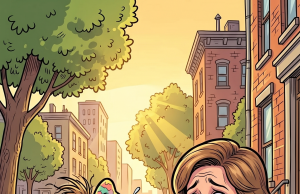
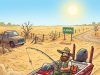
The Florida heat that day wasn’t just hot—it felt furious. It pressed down on Route 41 until the asphalt shimmered like a mirage, reeking of tar and exhaust.
My name is Lily. I was ten, small for my age, with scraped knees and hair that never stayed in a braid. That Tuesday, the world felt heavy, and most of that weight sat in the woven basket hooked over my elbow.
Oranges.
Twenty of them—bright, round, sun-sweet. I’d picked them from the wild grove behind our trailer park at dawn, while the grass was still wet with dew.
“Be careful, Lil,” my mom whispered from her bed. Her voice sounded like dry leaves rubbing together. She hadn’t gotten up in two days. The pill bottle on the nightstand was empty—only a dusting of white powder left at the bottom.
“I will, Mama,” I promised, tucking the blanket around her shoulders even though it was eighty degrees inside the tin can we called home. “I’ll sell them all. I’ll bring back the blue medicine.”
Four hours later, I’d sold exactly three.
I’d walked miles, leaving the dusty trailer park behind and stepping into the trimmed, quiet streets of the Gables—the neighborhood where lawns were greener than money and gates were taller than trees.
“Oranges?” I called, my voice cracking. “Sweet oranges?”
A silver car flew past without slowing. A woman walking a poodle crossed the street as if poverty were contagious.
My legs burned. My throat felt like sandpaper. I touched the three crumpled bills in my pocket. I still needed fifteen more.
I couldn’t go home without the medicine. I couldn’t listen to Mama cough through another night—that wet, rattling sound that made her whole chest shake.
Then I looked up the hill.
At the top, behind a wrought-iron gate that looked like lace made of steel, sat the biggest house I’d ever seen. It wasn’t a house. It was a palace—white columns, a fountain spraying water into the air (wasting it, I thought bitterly), and windows that caught the sky like mirrors.
Maybe they had money. Maybe they liked oranges.
I took a breath, lifted the basket higher, and started climbing.
The voice at the gate
The driveway was long, paved with neat brick like a puzzle. I stopped at the pedestrian gate. A gold call box sat on a stone pillar, a single button shining.
I hesitated. My mother always told me to stay invisible.
“Don’t make noise, Lily. Don’t let them look at you too long.”
She was afraid of the landlord, afraid of the police, afraid of shadows.
But fear didn’t buy antibiotics.
I pressed the button.
I waited. The sun beat down on my neck. Shame warmed my cheeks, and I almost turned away—until the box crackled with static.
“Delivery goes to the rear.”
“I… I’m not a delivery,” I squeaked. I cleared my throat and tried to sound brave. “I’m selling oranges. Fresh from the grove. Sweetest in the county.”
Silence.
My fingers tightened around the basket handle. “Please. They’re only a dollar. Or… fifty cents if you buy two.”
Static again. “Oranges?”
“Yes, sir. Fresh-picked.”
“It’s a hundred degrees out there, child. Why aren’t you in school?”
“My mom is sick,” I said before I could stop myself. “I need money for the pharmacy.”
A long pause. I thought he’d hung up. I lowered my head and turned to leave.
Then—
BZZZT.
The heavy iron gate clicked and swung inward.
“Come to the front door,” the voice said. “It’s too hot for a child to stand on pavement.”
Marble cold
Walking up to the house felt like stepping into a dream. The air smelled like jasmine and cut grass instead of diesel and dust. The fountain burbled cheerfully.
The front door was massive—dark wood with glass panels. Before I could knock, it opened.
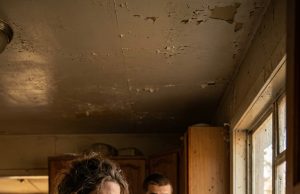
An old man stood there. Not a tuxedo, not movie-star rich. Just a beige cardigan—in this heat—and slacks. He leaned on a cane with a silver lion’s head. White hair. A face carved with sorrow.
His blue eyes were sharp, but not unkind. They took in my dirty sneakers, my sunburned nose, the heavy basket.
“Come inside,” he said, stepping aside. “Before you melt.”
I hesitated. “My shoes are dirty, sir.”
“Marble wipes clean,” he replied. “Come.”
The air-conditioning hit me like a wall—icy, crisp, clean. The silence inside wasn’t peaceful. It was museum-silence. Loneliness sealed in expensive rooms.
The hallway was wider than my entire trailer. A chandelier glittered overhead.
“Go to the kitchen,” he said, pointing with his cane. “I’ll get my wallet. I’ll take all the oranges.”
“All of them?” My heart leapt. “Sir, that’s… seventeen dollars.”
“I’ll give you twenty if you drink a glass of water,” he said. “You look dehydrated.”
He turned and moved slowly toward a study.
I headed for the kitchen, my shoes squeaking on polished stone. I felt tiny. Out of place.
I passed a table beneath a spiral staircase. A vase of white lilies sat in the center, surrounded by silver picture frames.
I don’t know why I stopped.
Maybe it was the lilies. My name was Lily, after all.
I glanced at the photos—one of the old man shaking hands with a president, another of a stern woman in a hat.
Then the one in the middle made my body go still.
A large 8×10 in a heavy silver frame.
A young woman sat on a garden bench—this garden, I realized, seeing the fountain behind her. A pale blue dress, silk-looking. Diamonds at her throat. Golden hair falling in soft waves.
She was smiling. Bright, alive, radiant.
I knew those eyes. One slightly greener than the other. I knew that small bump on the bridge of her nose.
I knew that smile—even though I hadn’t seen it like that in years.
“Mama?” I whispered.
It didn’t make sense. My mom didn’t wear silk. She didn’t own diamonds. She didn’t have money for aspirin. Her hair was thin, graying, tied back with cheap rubber bands.
But the woman in that frame was her.
Healthy. Rich. Happy.
My mind couldn’t hold it.
Why was my trailer-park mother sitting on a millionaire’s table?
“Here we are,” the old man said behind me.
I jumped. My elbow knocked the basket.
Oranges spilled across the marble—thump, thump, thump—rolling under the table, scattering toward the old man’s feet like bright little suns ruining a perfect hallway.
“I’m sorry!” I cried, dropping to my knees. “I’m so sorry!”
He didn’t get angry. He chuckled softly. “Leave them. The maid will pick them up. Here.”
He held out a crisp twenty-dollar bill.
I didn’t take it.
I stood slowly, pointing at the picture with a trembling finger.
“Sir… why do you have a photo of my mother?”
His expression collapsed. The hallway seemed to drain of air. He looked at the photo, then back at me—eyes widening with something like fear.
“What did you say?” he whispered.
“That woman,” I said, voice shaking. “In the blue dress. That’s my mom. That’s Elena.”
His cane fell, clattering on the marble like a gunshot.
“Elena?” he choked. “You call her Elena?”
“Yes. Elena Vance. She’s my mom.”
He stared at my face like he was searching for proof. His gaze landed on my eyes—the mismatched colors I’d inherited.
He made a sound that was half gasp, half sob.
“That’s impossible,” he whispered. “Who sent you? Is this a cruel joke?”
“No, sir!” Tears stung my eyes. “She’s sick. She’s at home. I’m selling oranges for her medicine. Why do you have her picture?”
He grabbed my shoulders, desperate.
“Child,” he rasped, trembling, “the woman in that photo… is my daughter. Eleanor. Not Elena. Eleanor.”
I shook my head. “No. My mom is alive.”
“And my daughter died,” he whispered, each word heavy. “A boating explosion seven years ago. I identified her myself.”
The world tilted.
“Where is she?” he demanded. “Where is your mother?”
“The Whispering Pines trailer park,” I stammered. “Down Route 41.”
He turned and roared toward the back of the house, calling his driver.
“ARTHUR! GET THE CAR!”
Then he faced me again, hope and terror warring in his eyes.
“If you’re telling the truth,” he said, voice shaking, “then who is buried in my family crypt?”
The chase and the key
We sped to the trailer park in a gleaming luxury car that looked like it didn’t belong on those cracked gravel roads. People stared. Someone dropped a laundry basket.
But when we reached my trailer—
My mother was gone.
The bed was empty. The room smelled of sickness and old coffee. Panic rose like fire in my throat.
Then Mr. Sterling spotted something on the table: an envelope with my name on it.
Lily.
My hands shook as I tore it open.
Inside was a letter… and a key.
My darling Lily,
I saw you leave this morning. I knew you would find him.
If you’re reading this, your grandfather has found us—
or you found him.
He thinks I died. It was the only way to save you.
Don’t trust him, Lily. Don’t trust the tears.
He doesn’t know the truth about the accident.
Run.
Love, Mom.
I looked up.
Mr. Sterling had been reading over my shoulder.
His face changed—not softer, not sadder.
Colder.
He reached for the letter and crushed it in his fist.
“She has a vivid imagination,” he said flatly, as his driver stepped into the doorway—blocking the exit.
Then Mr. Sterling turned to me, and the kindness in his eyes was gone.
“You’re a Sterling now, Lily,” he said. “And Sterlings don’t live in trailers.”
He reached for me.
I looked at the window.
Small… but I was small too.
I screamed, threw the only thing I had—a single orange from my pocket—right at his forehead.
And I ran.
The storage unit and the truth
The key led me to a storage facility: Unit 204.
Inside: a red duffel bag packed with decent clothes and stacks of cash. Then a metal box filled with documents that made my stomach drop.
Birth certificates.
Not Lily Vance.
Lily Sterling.
And my mother’s name: Eleanor Sterling.
There was also a brittle newspaper clipping:
STERLING HEIRESS DEAD IN BOATING EXPLOSION.
And a journal entry from the night before the “accident,” revealing the truth: my grandfather didn’t just lose his daughter—he tried to control her, label her unstable, lock her away. She’d discovered tampering on the boat. She believed she would die if she boarded.
So she did the only thing she could.
She “died” to survive.
And she was pregnant—with me.
I dropped the journal, ice flooding my veins.
Then a voice spoke from the darkness.
“Smart girl.”
I spun around.
A woman stepped into the dim light, hoodie pulled low, hand pressed to her side.
“Mama!” I cried.
She was pale, shaking, hurt—but alive.
She hugged me, trembling, and grabbed the bag.
“We have to go,” she whispered. “He owns this town. The sheriff. The cameras.”
We tried.
But black SUVs boxed us in.
Mr. Sterling stepped out—not frail anymore, not gentle. His eyes were cold as glass.
He said he would take us both. He promised a “private” facility for my mother… forever.
And he looked at me like I was property.
My mother did something desperate to buy us time—igniting a wall of flame near the propane tanks to force them back. We escaped through mud and drainage pipes, coughing in the dark.
But she collapsed near an abandoned diner, feverish and bleeding.
She pressed car keys into my hand and told me to hide in an old Civic under a tarp.
Then she made the hardest choice.
She yelled to draw them away.
I ran.
The call that changed everything
Inside the hidden car, I found a flip phone. On the sun visor, in black marker:
THE TEACHER.
I dialed.
A man answered, sleepy and wary.
“I… I have oranges,” I whispered.
The line went silent.
Then he inhaled sharply.
I told him my name. I told him my mother was Eleanor—and that the man with the silver cane had taken her.
His voice turned hard.
“Lock the doors. Don’t open for anyone but me. I’m coming.”
When he arrived in the rain, he didn’t look like a teacher. He looked like a storm in a leather jacket.
And when he shone the flashlight on his face, I saw it—his nose, his chin—like mine.
He pulled me into his arms.
“I’ve got you,” he whispered, shaking. “I didn’t know. God… I didn’t know.”
Then he said the sentence that rewrote my life:
“I’m your father.”
He didn’t take me to the police. He said Sterling owned them.
Instead, he drove straight to the mansion—ramming the gate with his truck.
He carried a battered briefcase.
Inside: proof. Offshore accounts. bribes. illegal dumping. and—most damning of all—evidence that Eleanor’s death certificate had been falsified.
He faced Sterling on the doorstep and made one demand:
“Let her go… or I burn your legacy to the ground tonight.”
For the first time, Sterling hesitated.
He saw something money couldn’t buy.
A man with nothing left to lose.
Sterling ordered his driver to lower the gun.
And my mother stumbled out—soaked, restrained, but walking.
My father caught her before she fell.
I ran to them.
The three of us—mud, rain, tears—crashed together on the marble steps.
We left the mansion behind.
And when I looked back, Sterling stood alone under his chandelier—small inside a huge, empty house.
My mother was still sick. Still shaking.
But for the first time in my life…
she looked safe.
[THE END]