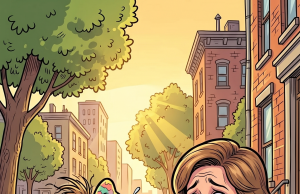
New York’s December skyline shimmered like a promise, but for Nathan Carter—a 39-year-old tech billionaire—it only sharpened the loneliness he’d perfected hiding behind custom suits and quarterly earnings calls. His Central Park penthouse was immaculate for Christmas: imported ornaments, a towering twelve-foot tree, soft golden lights. Yet the space felt empty, as though beauty itself had lost its warmth.
Nathan stood near the tree, an untouched glass of wine in his hand, when Rosa Martinez, his housekeeper, came in to finish her shift. Trailing behind her was her five-year-old son, Leo, his Santa hat slipping over his eyes as he walked. They were heading home, ready for the kind of Christmas Nathan hadn’t known in decades.
Leo stopped and looked up at Nathan with unfiltered curiosity.
“Mom… why is he having Christmas all by himself?”
Rosa stiffened, embarrassed. “Leo, sweetheart—that’s not polite.”
But Nathan wasn’t offended. The question struck deeper than any high-stakes negotiation ever had, settling quietly in a place he rarely allowed himself to feel.
After a moment, Rosa spoke gently. “Mr. Carter… my family’s having Christmas dinner tonight. It’s very simple, nothing fancy, but… you’d be welcome to join us.”
Nathan offered his practiced smile. “Thank you, Rosa. I’ll be fine.”
Leo tugged lightly on Nathan’s coat. “No one should be alone on Christmas.”
They left, and the silence rushed back into the penthouse like a cold tide. Nathan paced, sat, stood again—circling the emptiness of his own life. He stared at the unused place setting across the table. Business calls went unanswered. A book lay unread. Only Leo’s words echoed: No one should be alone on Christmas.
At 8:55 p.m., Nathan grabbed his coat.
At 9:03, he stood outside Rosa’s small brick house in Queens, crooked Christmas lights blinking like shy smiles. He raised his hand to knock—
The door opened.
Warm laughter spilled out. Cinnamon and roasted chicken filled the air. A cramped living room buzzed with people who clearly belonged to one another. Rosa stood there in a Santa-print apron, surprise softening her face.
“Nathan,” she said quietly. “You came.”
As he stepped inside, his phone vibrated.
Daniel Carter — Father.
Everything inside him tightened.
His father never called unless it involved the company—the legacy Nathan had inherited but never chosen. Nathan stepped into the hallway and answered, bracing himself.
“I heard where you are,” his father snapped.
“How?” Nathan asked.
“You forget how many people answer to me. Going into an employee’s home like this—it’s reckless. It damages your image. Our image.”
Nathan glanced back at the living room—Leo hanging ornaments on a plastic tree, Rosa’s sisters laughing, warmth existing without permission.
“What do you want?” Nathan asked.
“You will leave. Now. End this… situation. If you don’t, I’ll push the board to remove you.”
The call ended.
Nathan slipped the phone into his pocket, feeling the familiar weight of expectations over choice. Then Leo ran up, grabbed his hand, and pulled him back inside.
“Come sit by me! We saved you a seat!”
The chair was too small. The table was crowded. The decorations mismatched. Yet Nathan felt more present than he had in years.
They ate. They laughed. Rosa’s brother taught him a ridiculous card game. Her mother insisted on seconds. Rosa watched him quietly, sensing the turmoil behind his calm exterior.
After dinner, Rosa handed him a small wrapped box.
“It’s nothing big,” she said. “Just something small.”
Inside was a handmade wooden ornament shaped like a key. Burned into it was a single word:
Home.
Nathan swallowed. “I didn’t bring anything.”
“You being here is enough,” Rosa replied.
Still, his father’s threat lingered like a closing door. Nathan apologized and left early. Rosa understood without words.
Two days passed. Rosa didn’t return to work—she needed time, and Nathan respected that. He spent those days staring at the ornament, wondering how one simple word had undone years of emotional armor.
Finally, he returned to her house.
When Rosa opened the door, Nathan said what he’d never dared to before:
“I’m done living someone else’s life.”
The next morning, he stood in the Carter Enterprises boardroom—suit crisp, hands steady, heart racing. His father sat at the head of the table, still claiming authority long after stepping down.
Nathan spoke clearly. “I’m not leaving the company. But I am leaving the version of myself you created.”
His father scoffed. “You know the cost of defiance.”
“If choosing my own life costs me everything,” Nathan said, “then I accept it.”
The room stirred—but not against him. One by one, board members spoke. They didn’t see weakness. They saw a leader who finally understood people.
“We support Nathan,” one said.
“He’s the future of this company,” another added.
For the first time, Nathan’s father stood powerless in a room he once ruled.
That evening, Nathan returned to Rosa’s house—without hesitation or fear. Just certainty.
Rosa opened the door, uncertainty flickering—until she saw the wooden ornament in his hand.
“I choose this,” Nathan said softly. “I choose you. I choose a life that feels real.”
Rosa stepped forward and hugged him. Leo ran in and wrapped his arms around them both.
And for the first time in decades, Nathan felt something settle inside him—not success or achievement, but peace.
As Christmas lights glowed through the window and Nathan hung the small wooden key on Rosa’s tree, he finally understood:
Home wasn’t something he bought.
It was something he showed up for.